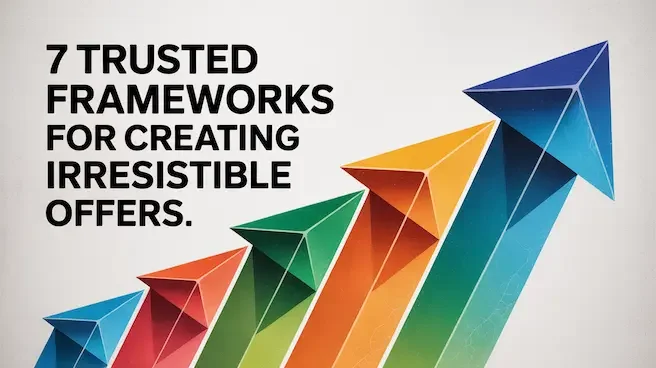
7 Trusted Frameworks for Creating Irresistible Offers That Enable CEOs to Outshine Competitors
The Strategy That Separates Market Leaders from the Rest
Many business leaders struggle to articulate why customers should choose them. Successful companies stand out not because they have better products or work harder. It’s how they create their offers that makes them stand out. Top businesses excel at creating offers. They transform solutions into compelling propositions that meet market needs. This skill turns ordinary products into must-have solutions.
Your ability to craft appealing offers influences whether prospects buy or walk away.
The 7 Essential Frameworks That Transform Standard Offers into Revenue Machines
1. The Problem-Solution Bridge
Customers buy better versions of themselves, not products.
Every sale starts with a prospect’s dissatisfaction about something specific. Their current situation has friction points or unresolved challenges they want to fix. Compelling offers do more than list features. They demonstrate how these features can transform pain into a positive outcome, making the change feel effortless and confident.
The gap between where customers are and where they want to be is your chance to create value.
2. The Urgency Amplifier
Nothing kills sales faster than a delay in decision-making.
Powerful offers present clear reasons why acting now is better than waiting. This isn’t about manipulation; it’s about showing the real delay costs. Innovative leaders measure costs that matter to prospects. They focus on lost revenue and missed opportunities, which can worsen over time.
Every day, customers wait for your solution, which costs them. So, make that cost clear in your offer.
3. The Risk Reversal Formula
Doubt is a hidden competitor in every sale.
Even when your solution fits a prospect’s needs, fear of making a bad choice can stop them. Great offers reduce worries. They shift risk from the buyer to the seller using guarantees, trial periods, and support. The best risk reversals tackle two types of risk. First, there’s performance risk, which asks, “Will this work?” Second, we have implementation risk, which asks, “Can we make it work?”
The business that takes on the most risk usually captures the market share.
4. The Competitive Wedge
Prospects compare you to alternatives, whether you acknowledge it or not.
Strong offers don’t ignore competition, but change how prospects check their options. This framework sets new decision-making criteria that favor your unique approach. Instead of focusing on price or features, focus on what makes your solution stand out.
Positioning doesn’t involve claiming superiority but changing how people make comparisons.
5. The Value Stack Architecture
Perceived value drives how much customers are willing to pay.
Great offers layer various value dimensions to create a greater whole. Core deliverables are essential. Support and community access add extra value. The best offers come with aspirational elements. They offer exclusive access, show status, and create future opportunities. These aspects delve into people’s true motivations.
How you present value is often more important than the actual value you provide.
6. The Objection Neutralizer
Every significant offer faces common objections.
Proactive leaders address objections directly in their offers. They don’t hope they won’t arise. This isn’t defensive at all. It shows confidence by acknowledging shared concerns and presenting solutions. Anticipating objections demonstrates your deep understanding of the market. It also helps the decision-making process proceed without obstacles.
The offer that addresses objections early creates the fastest path to sale.
7. The Narrative Framework
Facts inform, but stories transform.
Winning offers tie key benefits to a story that aligns with the prospect’s identity and goals. This framework connects product features to essential results. It tells a story in which the customer is the hero, and your solution is key. The narrative gives context that makes features relevant and benefits believable.
People buy based on their stories about your offering, not the facts.
Implementation: From Framework to Revenue
These frameworks are practical tools for immediate use.
Turn these principles into action by evaluating your offers. Identify the frameworks that need the most work. These are your best opportunities for improvement. Gather direct customer feedback focused on these areas to close perception gaps and improve customer satisfaction. Start by prioritizing changes that could have the most impact. Focus first on frameworks that address your customers’ main decision drivers.
The best strategies focus on one framework at a time. This approach works better than trying to change everything all at once.
What Happens When You Don’t Master This Skill
Failing to create compelling offers leads to predictable, costly issues.
Weak offers make it harder for businesses. They spend more to attract customers. Sales cycles are longer, and they are more price-sensitive. Their growth relies on market conditions rather than strategic positioning. Companies that lack a straightforward method for creating offers may become like commodities. They will compete on price, not on value.
In a competitive market, the best offer wins. This happens no matter the product’s quality.
The Skeptic’s Corner: Why This Matters Even If You Have Superior Products
Many believe exceptional products sell themselves, but this is a dangerous assumption.
The market has many great products that have failed. Meanwhile, lesser ones thrived with better offers. While product excellence is essential, offering construction shapes market perception. Being skeptical of “marketing tricks” might feel like valuing quality. However, the market requires precise positioning to understand the actual value.
History shows that lesser competitors with more attractive offers can outperform superior products.
The Competitive Edge: What Others Won’t Do
Most competitors focus on product development, ignoring offer refinement.
This creates an opportunity for market differentiation without requiring significant product changes. While others chase features, you can stand out by reshaping your offers. The best companies mix product upgrades with changes to their offers. They know that how customers view them is key, even more than having top-notch features.
Your most significant edge comes from how you show value, not the value itself.
Taking Action: Your Next Steps
Transforming your standard offers into compelling propositions requires immediate action.
Document your current offer structure. Then, explain how you use each of the seven frameworks. Find the three frameworks where you struggle the most. These areas offer the best chances for improvement. Next, examine how top industry companies structure their offers. You can take ideas that fit your needs. Revise your offer with these changes. Test it with a small group before launching it to a larger audience.
Leaders who improve processes often perform better than those who only upgrade products.
Transform Your Business with Premium Resources
Understanding frameworks is only the first step. Implementation is where real market advantage happens.
Many business leaders understand the value of these seven frameworks. Yet, they often find it challenging to apply them consistently. The difference between market leaders and everyone else isn’t knowledge—it’s execution. Premium subscribers say our tools save them weeks of work. They also help avoid thousands in consulting fees. They transform theoretical concepts into practical revenue drivers within days, not months.
Execution tools create results that knowledge alone cannot deliver.