The Great Service Pricing Delusion
Here’s the truth that many service providers struggle with: premium pricing doesn’t have to be high. It means being irresistible at any price.
Research from Harvard Business School shows that clients prefer results over hourly rates. Yet, you still stress over charging $200 or $250 per hour.
Meanwhile, McKinsey charges $40,000 per week for a junior consultant. Are they 100 times better than you? Probably not. But they’ve mastered the psychology of premium pricing.

Why Service Businesses Are Premium-Pricing Gold Mines
Services offer three significant advantages for premium pricing:
First, you sell outcomes, not time. When clients hire you, they want their problem solved. That’s worth a lot to the right client. Second, you’re hard to compare. Explain to someone why one consultant charges $500/hour and another charges $5,000/hour. You can’t, because service delivery is unique. Third, services scale with value, not cost. Your advice that saves a client $2 million costs the same to deliver as advice that saves $20,000. Guess which one gets premium pricing?
Bain & Company found that firms good at value-based pricing can achieve profit margins 30-50% higher than those using cost-plus pricing. Yet many still bill like they’re running a taxi meter.
The Five Pillars of Premium Service Pricing
1. Expertise Positioning: Become the Obvious Choice
Stop being a “marketing consultant.” Be “the person who helped 47 SaaS companies hit $10M in revenue.” Specificity boosts your pricing power.
The highest-paid lawyers aren’t generalists—they handle billion-dollar mergers. Top consultants don’t solve “business problems” but fix particular, expensive issues.
2. Outcome-Based Pricing Models
Hourly billing kills profit margins. Innovative providers use these premium models instead:
Project-Based Pricing: “I’ll solve your customer retention issue for $25,000.” Value-Based Pricing: “My solution saves you $500,000 annually. My fee is $100,000.” Retainer Models: “For $15,000/month, I’m your on-call growth advisor.” Results-Based Pricing: “I get paid when you see results.”
3. The Scarcity Strategy
Nothing drives premium pricing like the fear of missing out. Limited availability isn’t just a tactic—it’s a business model.
“I take on three new clients per quarter.” “My calendar opens in November.” “I have one spot left in my CEO advisory program.”
When clients can’t have you right away, they want you more. When they want you more, they pay more. It’s basic behavioral economics.
4. Premium Service Delivery
Charging premium prices means offering a premium experience. This doesn’t mean fancy office supplies; it means making clients feel smart for hiring you.
Premium Communication: Weekly video updates instead of email reports. Slack access instead of scheduled calls. Same info, different feel.
Premium Access: Direct phone number. After-hours availability. VIP treatment justifies VIP pricing.
Premium Results: Under-promise and over-deliver, turning clients into your best salespeople.
5. Value Communication Mastery
The difference between premium pricing and objections isn’t your service—it’s how you discuss it.
Bad: “I charge $300/hour for marketing consulting.” I help companies make seven figures and add an extra million in revenue. We do this through marketing optimization. My typical fee is $30,000.” Bad: “My project takes 3-6 months.” Good: “In six months, you’ll have a marketing system that generates leads while you sleep.”
The first version sells time. The second version sells transformation.
The Premium Pricing Mindset Shift
What sets premium providers apart from hourly wage earners?
Premium providers think: “What’s this worth to my client?” Everyone else thinks: “What can I charge?” Premium providers say: “My fee is $50,000.” Everyone else says, “My rate is $500/hour, but I could do $450.” Premium providers position: “I solve expensive problems for successful companies.” Everyone else positions: “I’m affordable and flexible.”
Common Premium Pricing Mistakes (and How to Avoid Them)
Mistake #1: The Incremental Increase. Raising your rates from $200 to $220/hour isn’t premium pricing. It’s just inflation. Premium pricing means a complete change in how you price.
Mistake #2: The Apology Tour “I know this seems expensive, but…” Stop there. Apologizing for your price means you’ve lost. Premium pricing needs confidence, not excuses.
Mistake #3: The Feature Festival. Listing too many items won’t justify high prices; it just confuses clients. Premium clients buy outcomes, not checklists.
Mistake #4: The Discount Trap. “What’s your budget?” is deadly for premium pricing. Start with value, not with what they can afford.

Making the transition to premium pricing.
Switching to premium pricing isn’t instant; it’s gradual. Here’s your flight plan:
Phase 1: New Client Testing. First, test premium pricing with new prospects. Existing clients have set expectations that are harder to change.
Phase 2: Service Packaging. Bundle services into premium packages, not à la carte. “Strategic Growth Intensive” sounds more premium than “eight hours of consulting.”
Phase 3: Market Positioning. Update your website, LinkedIn, and proposals to reflect your premium position. You can’t charge premium prices with bargain messaging. Phase 4: Client Portfolio Evolution. Not all clients will make the transition with you. That’s fine. Premium pricing naturally attracts premium clients.
See our Premium Pricing Strategy Guide to learn how to implement premium pricing.
The Premium Pricing Psychology Your Clients Won’t Tell You
Clients’ brains link price with quality. A $10,000 consultant must be better than a $1,000 consultant, right?
This isn’t logical—it’s psychological. And psychology often trumps logic in buying decisions.
Harvard Medical School conducted a study. Patients on “expensive” pain meds (placebos) felt better than those on “cheap” meds (the same pills). This means how much people think a drug costs can affect how well it works for them.
Your clients experience this too. Premium-priced services often perform better in their minds because they expect better results.
Advanced Premium Pricing Strategies
The Authority Tax: Show your expertise in your niche and set your rates high. Simon Sinek doesn’t compete for leadership consulting—he sets the price.
The Transformation Premium: Don’t just sell better—sell differently. “I don’t make your marketing efficient; I make your business irresistible.”
The Access Economy: Create tiers for access to your expertise. The basic package includes email support, and the premium package provides your cell number.
The Results Guarantee: “If you don’t get results, you don’t pay.” Risky? Yes, but effective.
The Numbers Don’t Lie: Premium Pricing in Action
Let’s do some simple math that will make your accountant weep with joy:
Scenario A (Hourly Billing):
- Rate: $200/hour
- Billable hours/month: 120
- Monthly revenue: $24,000
- Annual revenue: $288,000
Scenario B (Premium Project Pricing):
- Average project: $25,000
- Projects/month: 2
- Monthly revenue: $50,000
- Annual revenue: $600,000
Same expertise. Same market. Same you. Double the income by changing how you price, not what you deliver.
Your Premium Pricing Action Plan
Week 1: Audit your current pricing model. Calculate your actual hourly rate, including all unbilled work.
Week 2: Research premium competitors’ charges. Please find your niche’s most expensive service provider and study their positioning.
Week 3: Package your services into outcome-based offerings. Create Good-Better-Best options.
Week 4: Test premium pricing with one new prospect. Monitor their reaction and adjust your value communication.
Month 2: Refine your premium pricing packages based on market feedback.
Month 3: Begin transitioning existing clients to new pricing models during contract renewals.
The Premium Pricing Promise
Here’s what happens when you finally stop undercharging:
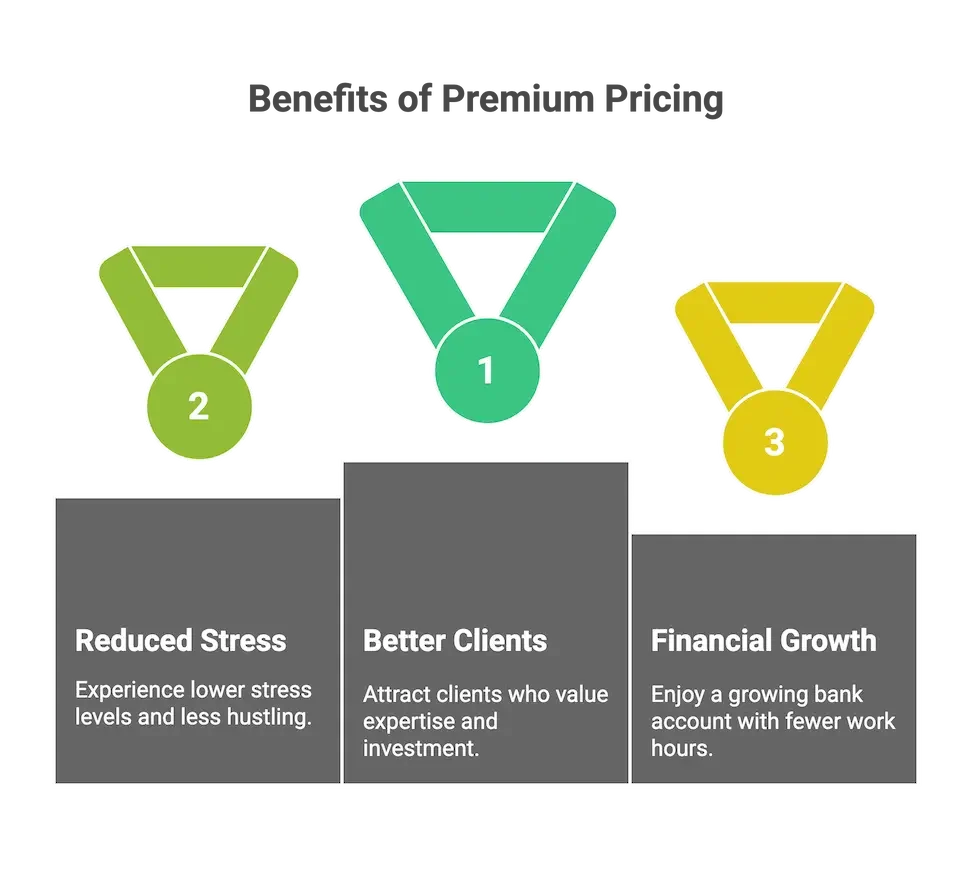
You work with better clients who appreciate expertise over discounts. Your stress levels plummet because you’re not constantly hustling for the next project. Your bank account grows while your work hours shrink.
Most importantly, you attract clients who see you as an investment, not an expense.
But here’s the catch: premium pricing only works if you believe you’re worth it. If you doubt your value, your clients will notice and take advantage.
Ready to stop leaving money on the table?
Premium pricing isn’t about being expensive—it’s about being valuable. It’s not just about raising prices. It’s about creating results that are so great that the cost doesn’t matter.
Your expertise is worth more than you’re charging. Your results speak louder than your hourly rate. Your clients’ success stories are better marketing than any discount you could offer.
The question isn’t whether you should implement premium pricing. The question is: how much longer can you afford not to?
Stop undercharging for your expertise. Start commanding the fees your results deserve.
Ready to transform your entire pricing strategy? Get the complete playbook that has helped many service providers double their prices. You won’t lose clients! Download our comprehensive Premium Pricing Strategy Guide and start charging what you’re worth.