
Myth #1: “Premium Pricing Only Works for Luxury Brands”
Saying only luxury brands can set high prices is like saying only tall people can reach the top shelf. Sure, height helps, but stepladders exist for a reason.
Every industry has its premium players. In accounting, your local guy charges $200 for taxes. PwC, on the other hand, charges $200,000 for major restructuring. Both are accountants, but one drives a Honda Civic while the other flies first class.
The Reality: Premium pricing works in any industry where expertise, results, or convenience matter more than low prices. That includes nearly every sector, even dollar stores (which now have premium options).
McKinsey found that firms using premium pricing can boost profits by 20-50% in 18 months. This applies to all companies, not just luxury brands. It also includes industrial equipment makers and software consultants.
Your customers want the best solution to their problem, not just the cheapest option. That’s a crucial difference.

Myth #2: “Customers Always Choose the Lowest Price”
This myth is so wrong that it makes flat-Earth theory seem logical.
If customers picked only the lowest price, Walmart would be the last retailer. McDonald’s would have wiped out fine dining, and you’d be reading this on a cheap Android tablet.
The Reality: Customers decide based on perceived value, not just price. Price is one part of a complex mix. Quality, convenience, status, trust, and other factors also play a role.
Harvard Business Review studies say customers spend more when they notice higher value. The keyword is “perceive.” Value is what your customer believes you deliver, not just what you offer.
Innovative companies focus on increasing perceived value, not lowering prices. This is the difference between racing to the bottom and building up.
Myth #3: “Premium Pricing Means Losing Customers”
This myth assumes your current customers are your ideal customers. Plot twist: they probably aren’t.
When you raise prices correctly, you may lose some customers. That’s okay. Those shoppers were price-hunting and costing you money anyway. You will attract better customers who value what you do and pay accordingly.
The Reality: Premium pricing filters customers; it doesn’t repel them. You’re trading quantity for quality, and your profit margins will improve.
Want the complete premium pricing playbook? Check out our comprehensive Premium Pricing Strategy Guide for the frameworks’ top companies use to justify higher prices.
One consulting firm raised its rates by 150% and lost 40% of its customers. Sounds bad, right? Wrong. Its revenue shot up by 90%, and its stress dropped significantly. It moved from working with penny-pinchers to clients who appreciated its expertise.
Myth #4: “You Need to Justify Premium Prices with Extra Features”
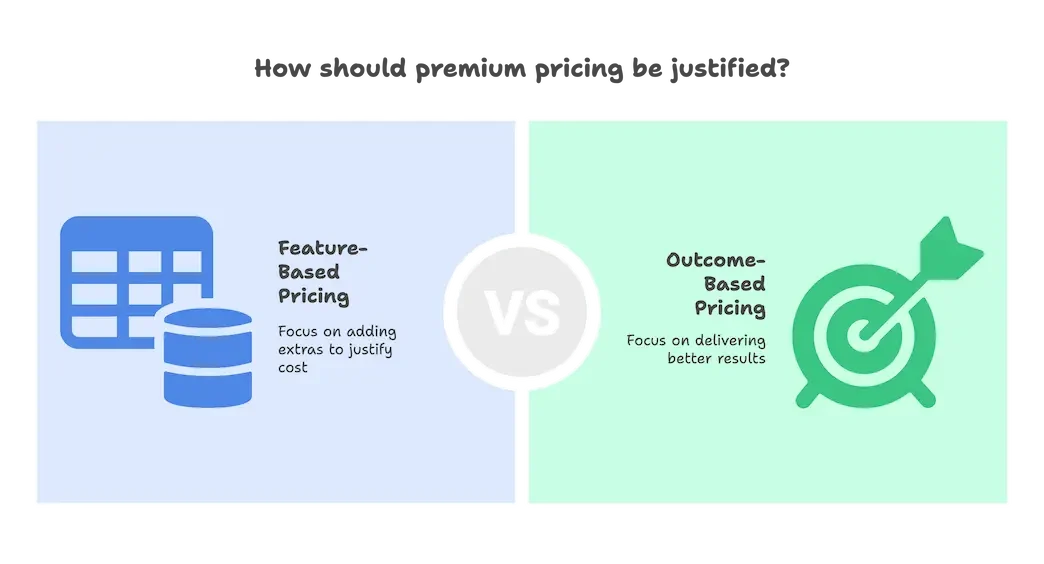
This is the “kitchen sink” approach. Companies pile on extras to make customers feel they’re getting their money’s worth.
This thinking is completely backward.
Apple doesn’t charge $1,200 for the iPhone because it has more features than a $300 Android phone. It charges that because it’s an iPhone. The premium comes from the brand, the experience, and the status people perceive. It doesn’t stem from extra features.
The Reality: Premium pricing is about better outcomes, not more stuff.
Customers pay for solutions that:
Your premium price should reflect the outcome’s value, not just the input costs plus a margin. That’s a big difference.
Myth #5: “Premium Pricing Requires Perfect Everything”
This perfectionist myth has held back many businesses.
The logic is: “We can’t charge premium prices until everything is perfect.” Meanwhile, your less capable competitors charge double your rates and thrive.
The Reality: Premium pricing means being better than the alternatives, not achieving perfection. “Better” is relative. “Perfect” is impossible.
Southwest Airlines has higher prices than bus travel, even if its service isn’t perfect. It’s not perfect; it’s just better than driving 14 hours to Phoenix.
Myth #6: “Economic Downturns Kill Premium Pricing”
This myth suggests that tough times make everyone a bargain hunter. It’s partly true but mostly not helpful.
Yes, some customers become more price-sensitive during tough times. But others look for value. They’ll spend more on reliable solutions. They can’t waste money on cheap options that don’t work.
The Reality: Economic uncertainty can boost demand for proven, reliable solutions. Customers prefer to partner with trustworthy companies. They want businesses that won’t vanish suddenly or provide subpar results.
In the 2008 recession, many premium brands increased their market share. Meanwhile, discount competitors faced challenges. Why? When money is tight, buyers focus on results, not prices.
Myth #7: “Premium Pricing Is Unethical Price Gouging”
Many business owners feel guilty about charging what they’re worth. This guilt often leads to a moral objection. They confuse premium pricing with price gouging.
Price gouging means charging $50 for a water bottle during a hurricane. Premium pricing is charging fairly for delivering superior value.
The Reality: Premium pricing is ethical when it reflects superior value. You’re not gouging customers but investing in better service and outcomes.
Charging too little can be less ethical. Underpricing forces you to cut corners and deliver mediocre results. That helps no one.
Myth #8: “You Need Market Research to Implement Premium Pricing”
This myth makes business owners think they must research and analyze before raising their rates.
That’s nonsense.
Market research can help with positioning, but it isn’t necessary for premium pricing. Successful implementations start with a clear idea: “We’re worth more than we charge.”
The Reality: Testing premium pricing with real customers gives the best market research. Start with the following proposal. Raise your prices by 30% and see what happens. You’ll learn more in a month than from months of research.
The Real Truth About Premium Pricing
The myths don’t tell you that Premium pricing isn’t about charging more for the same thing. It’s about positioning yourself as the best choice and delivering on that promise.
Every successful business faces the same choice: compete on price or value. Companies that choose price become commodities, while those that choose value become profitable.
Myths about premium pricing serve to keep the easily swayed focused on discounts. In contrast, savvy businesses prioritize premium positioning.
Your competitors can keep believing the myths. Your bank account will thank you for knowing more.
Stop apologizing for your prices and start justifying your value. The difference between these approaches can mean the difference between struggling and succeeding.
Premium pricing isn’t just for fancy brands. It’s a profit strategy for any business smart enough to use it.
Will you stick to the myths that hold back your competitors? Or will you choose the strategies that help innovative businesses succeed?
The choice is yours. Choose wisely.