

The Uncomfortable Truth About Your Current Market Strategy
Here’s what your strategy team won’t admit: you’re probably fighting over the same tired markets as everyone else, driving margins down and stress levels through the roof. While you’re locked in pricing wars with competitors, innovative CEOs use market discovery techniques to find new markets where competition doesn’t exist yet.
Market Discovery Techniques Quiz
According to the guide, what is the primary purpose of market discovery?
Which three types of market gaps create the most significant opportunities?
What is Blue Ocean Strategy’s core principle for market creation?
According to the guide, the most profitable opportunities usually come from:
What key advantage do companies gain by identifying trends 2-3 years before they become mainstream?
What Market Discovery Actually Means (Beyond “Looking for New Customers”)
Market discovery isn’t just expanding your current customer base or tweaking your existing offerings. It is a systematic method for uncovering entirely new market opportunities, untapped customer segments, unserved needs, or unexplored applications that meet your capabilities.
Netflix didn’t stumble into streaming by accident. They used deliberate market discovery to identify the shift from physical to digital entertainment consumption before Blockbuster saw it coming.
Core Elements of Effective Market Discovery:
- Systematic identification of market gaps and opportunities
- Understanding of emerging customer needs and behaviors
- Recognition of technological and social trend implications
- Strategic analysis of competitor blind spots and weaknesses
External Reference: According to Clayton Christensen’s research at Harvard Business School, companies that actively engage in systematic market discovery are 2.5 times more likely to achieve breakthrough growth than those focused solely on existing markets.
Finding the Gaps Everyone Else Missed
Market gap analysis is your secret weapon for discovering opportunities in plain sight. These gaps exist everywhere—between what customers need and what is currently available, between what competitors offer and what they ignore, and between emerging trends and market responses.
The Three Types of Market Gaps That Create Fortunes
Capability Gaps: Things customers need that no one can deliver well yet
Service Gaps: Areas where current solutions are clunky, expensive, or inadequate
Experience Gaps: Opportunities to dramatically improve how customers interact with a category
The companies making serious money aren’t competing in existing gaps – they’re creating entirely new categories.
Uncovering What Customers Actually Want (Before They Know They Want It)
Customer need identification goes deeper than asking customers what they want. Henry Ford’s famous quote applies here: “If I had asked people what they wanted, they would have said faster horses.”
Brilliant market discovery identifies:
- Expressed needs: What customers say they want
- Unexpressed needs: Problems they have but can’t articulate
- Delight opportunities: Solutions that exceed expectations in unexpected ways
- Future needs: What they’ll need as their world changes
The most profitable opportunities usually come from unexpressed and future needs.
Spotting Trends Before Your Competitors Wake Up
Trendspotting in market discovery isn’t about following fads but identifying fundamental shifts that create new market opportunities. The key is seeing the implications of trends before they become apparent.
Early Trend Indicators to Watch:
- Changes in customer behavior patterns
- Emerging technologies reaching practical application
- Regulatory shifts creating new requirements or opportunities
- Generational differences in preferences and expectations
- Economic or social changes affecting customer priorities
The companies that win big identify trends 2-3 years before they become mainstream.
Exploiting Your Competitors’ Blind Spots
Every company has competitor blind spots; market opportunities it can’t or won’t pursue due to its current business model, capabilities, or strategic focus. These blind spots are goldmines for brilliant market discovery.
Common Competitor Blind Spots:
- Customer segments are too small for large competitors but perfect for focused players
- Solutions that would cannibalize their existing revenue streams
- Markets requiring capabilities they don’t have and won’t develop
- Opportunities that don’t fit their brand positioning or target market
Your competitor’s constraint is your opportunity.
Leveraging Data and AI for Market Intelligence
Using data analytics for market discovery transforms market research from educated guessing to scientific discovery. Modern analytics can identify patterns, predict trends, and uncover opportunities that would be impossible to spot manually.
Data Sources for Market Discovery:
- Social media sentiment analysis for emerging needs
- Search trend data revealing growing interest areas
- Customer behavior analytics showing unmet needs
- Competitive intelligence on market gaps and weaknesses
- Economic and demographic data indicating market shifts
The most innovative CEOs use AI to discover markets their competitors don’t even know exist.
Global vs. Local Market Discovery Strategies
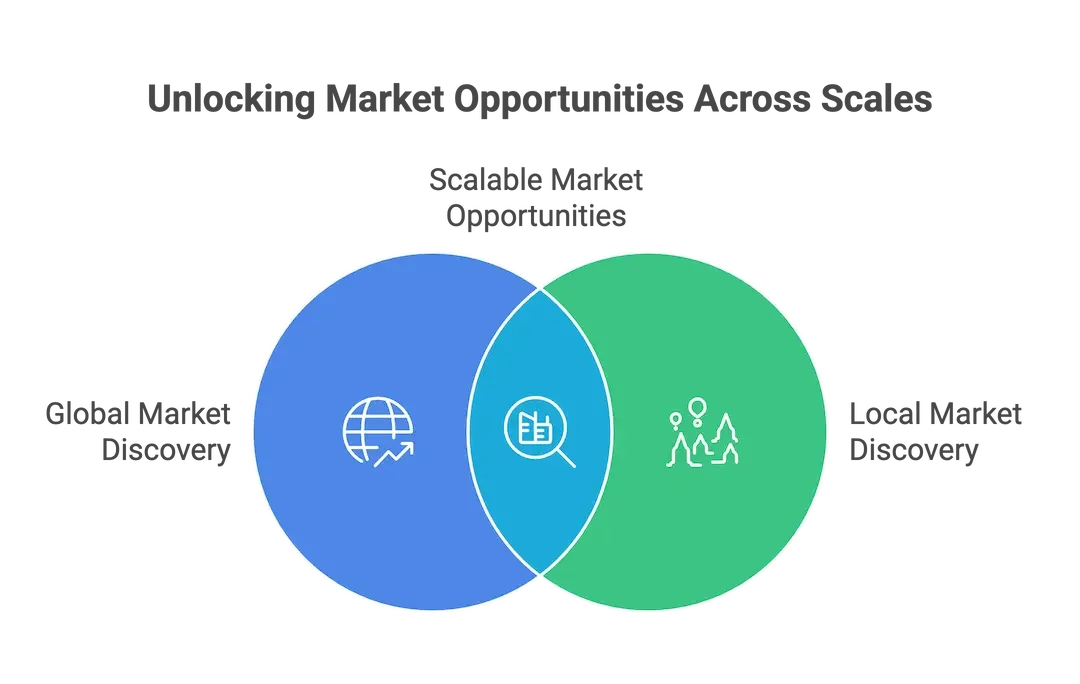
Market opportunities exist at every scale, from global market discovery of international expansion possibilities to local market discovery of hyperlocal niches.
Digital Economy Market Opportunities
Market discovery in the digital economy reveals opportunities unique to online, platform-based, and technology-enabled businesses. Digital markets move faster, scale differently, and create network effects that don’t exist in traditional markets.
Digital Market Discovery Focus Areas:
- Platform ecosystem opportunities
- Data-driven service possibilities
- Automation and AI application markets
- Digital transformation enabling services
- Remote and distributed market solutions
Digital markets often reward first-movers more dramatically than traditional markets.
Hands-On Market Discovery Methods
Market discovery workshops and exercises provide structured frameworks for systematically exploring opportunities. Surveys and customer interviews collect voice-of-customer data to identify real market gaps.
Workshop-Based Discovery
Customer Research Methods
Market Discovery for Different Business Stages
Market discovery for startups requires lean, rapid approaches that validate opportunities quickly without burning through limited resources. Market discovery for growth companies can invest in more comprehensive research and systematic exploration.
Startup Market Discovery
Growth Company Market Discovery
Global Market Discovery
Focus on cultural needs, regulatory differences, economic development levels, and infrastructure variations that create unique market opportunities in different regions.
Local Market Discovery
Blue Ocean Strategy for Market Creation
Blue Ocean Strategy systematically creates new market spaces rather than competing in existing ones. Instead of fighting in red oceans full of competitors, you create blue oceans of uncontested market space.
Blue Ocean Creation Process:
- Eliminate factors the industry takes for granted
- Reduce factors below the industry standard
- Raise factors above industry standard
- Create factors that the industry has never offered
The most successful market discoveries often create entirely new categories.
Essential Market Discovery Tools and Resources
Tools for market discovery range from simple research methods to sophisticated AI-powered market analysis platforms. The right tools depend on your resources, market complexity, and discovery objectives.
Market Discovery Tool Categories:
- Market research and analytics platforms
- Customer feedback and survey tools
- Competitive intelligence software
- Trend analysis and monitoring systems
- Data visualization and analysis tools
Investment in good tools pays for itself through better opportunity identification.
Targeting Early Adopters and Innovators
Early adoption curves help you identify the customer segments most likely to embrace new market solutions. Understanding adoption patterns is crucial for successful market entry and growth strategies.
Early Adopter Characteristics:
- Willing to accept imperfect solutions for early advantages
- Comfortable with higher risk and uncertainty
- Often, industry influencers and opinion leaders
- Value innovation over proven track records
Early adopters are your bridge from market discovery to market development.
Avoiding Market Discovery Pitfalls
Market discovery risks and pitfalls can turn promising opportunities into expensive lessons. Understanding common mistakes helps you navigate discovery more effectively.
Common Market Discovery Mistakes:
- Falling in love with opportunities before validation
- Underestimating the time and resources required for market development
- Ignoring competitive responses to new market entry
- Misreading customer willingness to adopt new solutions
- Overestimating market size or growth potential
Brilliant market discovery includes risk assessment and mitigation planning.
Testing and Validating New Market Ideas
Testing new market ideas reduces risk and increases success probability before making significant resource commitments. Validation should be systematic, objective, and include positive and negative indicators.
Market Testing Approaches:
- Pilot programs with early adopter segments
- Limited geographic or demographic testing
- Partnership-based market exploration
- Minimum viable product validation
- Pre-sales and market interest testing
Testing saves money and increases confidence in market opportunities.
Cross-Industry Innovation and Inspiration
Cross-industry market discovery borrows successful concepts, business models, and solutions from other industries and adapts them to new markets. Some of the most significant market discoveries come from connecting ideas across sectors.
Cross-Industry Discovery Methods:
- Studying successful models in other sectors
- Adapting technologies from different applications
- Applying service approaches from unrelated industries
- Combining capabilities from multiple sectors
Innovation often happens at the intersection of industries.
The Future of Market Discovery
Artificial intelligence, global connectivity, rapid technological change, and shifting customer expectations will shape the future of market discovery. Early preparation for these changes creates competitive advantages.
Emerging Market Discovery Trends:
- AI-powered pattern recognition in market data
- Real-time market opportunity identification
- Global market access through digital platforms
- Predictive analytics for trend identification
- Automated competitive intelligence gathering
Companies that master next-generation market discovery tools will have significant advantages.
Your Market Discovery Action Plan
Market discovery techniques aren’t just research methods – they’re your path to uncontested market opportunities and sustainable competitive advantages. While your competitors fight over shrinking slices of existing pies, you’ll be baking entirely new pies.
The companies dominating tomorrow’s markets are the ones discovering those markets today.
Ready to stop fighting for scraps?
- Conduct systematic market gap analysis in your current and adjacent markets.
- Implement customer need identification processes to uncover unexpressed requirements.
- Establish trendspotting capabilities to identify opportunities before competitors.
- Analyze competitor blind spots for immediate opportunity identification
- Test and validate the most promising opportunities before significant investments
Your next breakthrough isn’t in beating competitors in existing markets – it’s in finding markets where competitors don’t exist yet.
Stop hunting where everyone else is fishing. Start discovering the untapped waters where you can be the only game in town.
Research by McKinsey & Company shows that companies actively engaged in systematic market discovery achieve 15% higher revenue growth and 25% better profit margins than those focused solely on existing market optimization.